Sukkot
The Festival of Booths
Building little outdoor shelters and eating under the stars to remember a long journey
The feeling at the heart
Gratitude
The Story
What is the most special meal you have ever eaten? Maybe it wasn’t the fanciest food. Maybe it was a picnic on a blanket, or dinner outside on a summer night. Sometimes the place where you eat something makes it taste completely different. Sometimes eating outside, under the open sky, makes you feel alive in a way that eating inside never quite does.
There is a holiday built entirely around that feeling. A holiday where the most important thing you do is go outside and eat your meals under the stars — on purpose, every night, for a whole week.
After Moses led the Jewish people out of slavery in Egypt, they did not arrive anywhere right away. They wandered in the desert for forty years. They did not have houses. They lived in temporary shelters — rough little structures made of whatever they could find — and moved when they had to.
It was hard. But they were not alone. And they made it through.
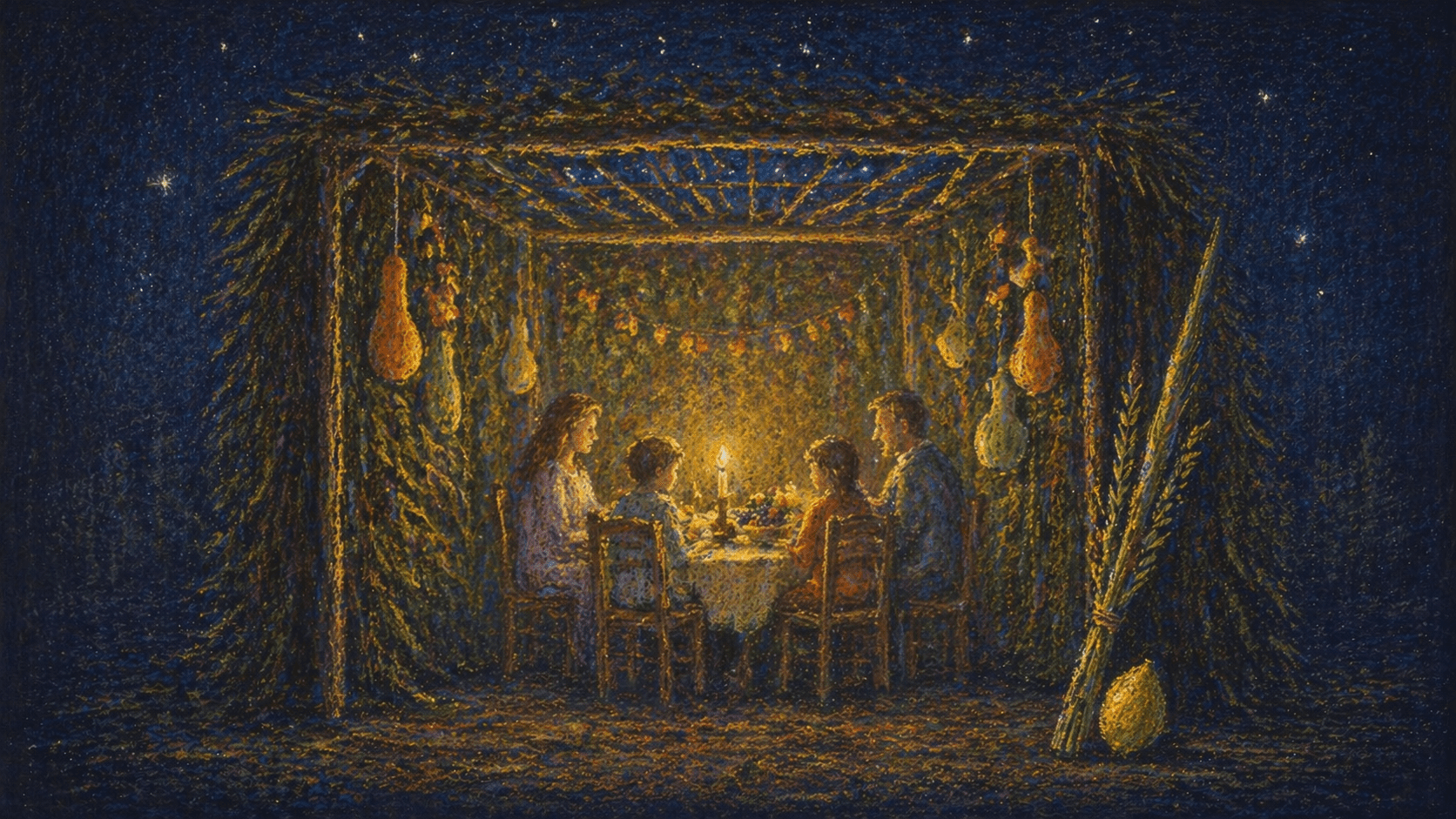
Every year, families build a small temporary shelter called a sukkah to remember those forty years in the desert. The roof must be made of branches and leaves, loosely laid, so that when you look up at night you can see the sky through the gaps. You can see the stars. That is the point.
How people celebrate today:
Building the sukkah is one of the best parts. Families build them in backyards, on apartment balconies, in parking lots, in synagogue courtyards — wherever there is a little bit of space. The walls can be wood or canvas, but the roof must be made of natural things: pine boughs, palm branches, bamboo, corn stalks.
Then comes the decorating. Children hang paper chains and drawings and dried fruits and gourds. Every sukkah looks different, and every one is beautiful in its own way.
Inside the sukkah, families eat. The smell of autumn air mixes with the smell of food. Candles flicker. If the night is cool, you can feel it, and pull your sweater a little tighter, and that feeling is part of it too.
There is something called the four species — four plants that are held together and waved in six directions during prayers: a palm branch, myrtle, willow, and a special citrus fruit called an etrog that smells bright and sharp and wonderful. The waving is a way of saying that God is everywhere.
Some families invite imaginary guests into the sukkah each night — great figures from Jewish history, like Abraham, or Sarah, or Moses. It is a way of feeling connected to everyone who has come before.
Sukkot says: you don’t need everything to be permanent to feel gratitude. Sometimes it is the temporary things — a leafy roof, a starry sky, a meal eaten outside with people you love — that fill you up the most.
You might see
A greeting to know
Chag Sameach
KHAG sah-MEH-akh
“Happy Holiday”