Navaratri
Nine Nights of the Goddess
Nine nights of dance and devotion celebrating the power of the Goddess
The feeling at the heart
Strength
The Story
Have you ever faced something that felt too big for you? Something that seemed so strong, so dark, so sure of itself that you wondered how anything good could possibly win?
The goddess Durga knows that feeling. And she has an answer.
Long ago, there was a demon named Mahishasura. He had been granted a gift: no man or god could defeat him. He believed this made him unstoppable. He marched across the heavens and the earth, spreading darkness. Even the most powerful gods fell back before him.
But there was something Mahishasura had not counted on.
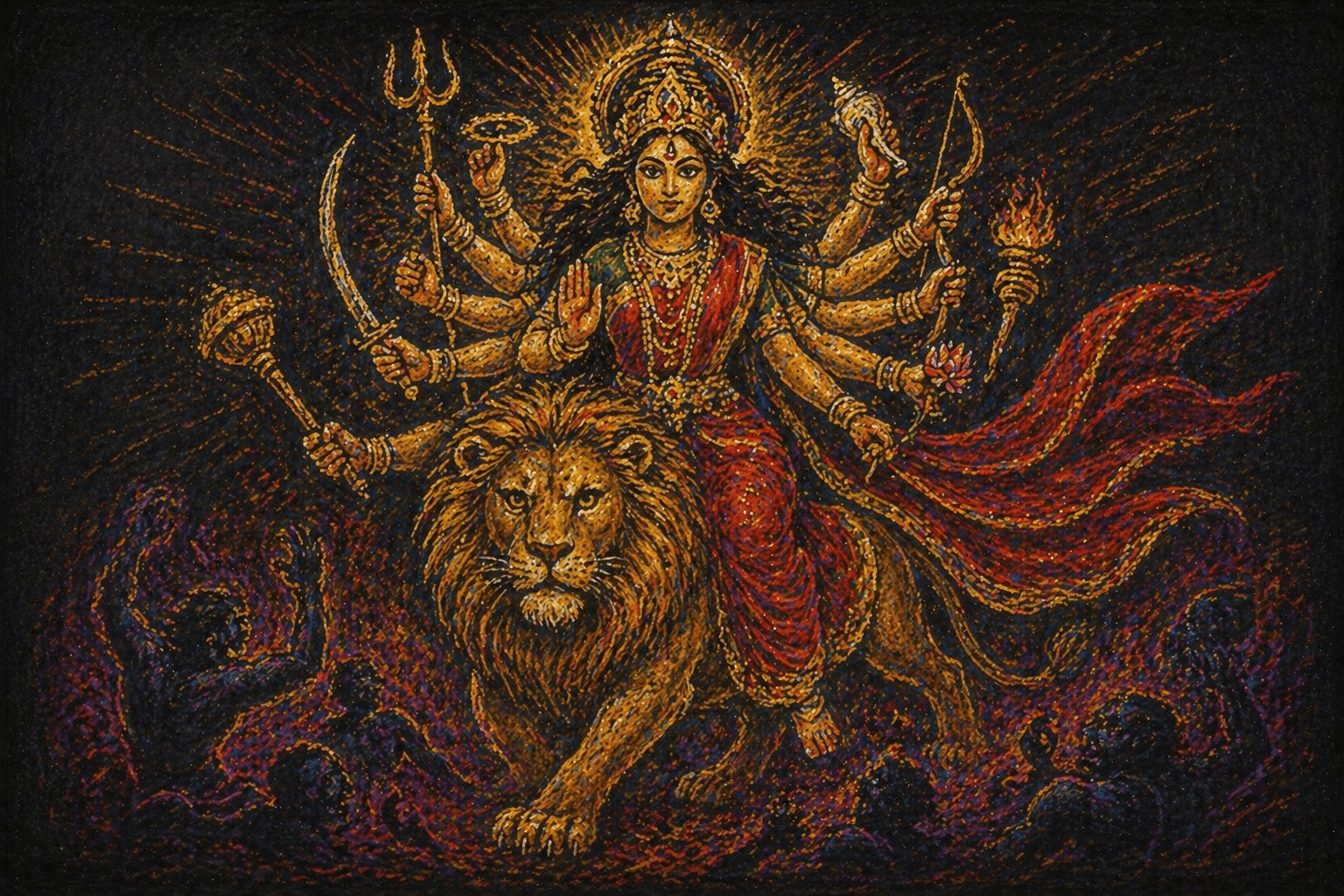
The gods gathered together and poured all of their strength into one blazing point of light. From that light, a goddess was born. Durga — whose name means the one who is difficult to defeat.
She was not afraid. She rode into battle on a lion. She had ten arms, and each arm held a different weapon, given to her by a different god. She was not one god’s power — she was all of their powers, woven together.
The battle lasted nine days and nine nights.
On the tenth day, she defeated him. Light came back. The gods could breathe again.
Those nine nights of battle are what Navaratri remembers. Nava means nine. Ratri means nights.
How people celebrate today:
In Gujarat, the nights fill with a dance called Garba. Hundreds of people, sometimes thousands, dress in bright swirling skirts and embroidered shirts, and they spin and clap and step in great whirling rings around a lamp or an image of the goddess. The music goes faster and faster. The colors blur. The clapping becomes thunder.
There is also a dance called Dandiya Raas, where partners tap small decorated sticks together in rhythms that look like pure joy once you know them.
In other parts of India, people build small stepped platforms in their homes and arrange figures on them — gods, animals, everyday people — called Golu or Kolu.
The goddess Durga is shown in many forms across the nine nights — as Shailaputri, the daughter of the mountains. As Chandraghanta, who wears a half moon. As Siddhidatri, who grants wisdom.
On the tenth day, called Vijayadashami, victory is celebrated. In some places, enormous straw figures of the demon are burned at nightfall. The sky lights up. Everyone cheers.
Darkness lost. It lost before. It can lose again.
And for nine nights, the dancing doesn’t stop.
You might see
A greeting to know
Happy Navaratri
nuh-vuh-RAH-tree
“Happy Nine Nights”