Rosh Hashanah
The Jewish New Year
A fresh start sweetened with apples dipped in honey
The feeling at the heart
Renewal
The Story
Have you ever stood at the very beginning of something? The first day of school, when everything feels new and a little bit uncertain. The first morning of a trip, when anything could happen. That feeling — of a door swinging open, of a blank page waiting — is one of the most hopeful feelings in the world.
There is a day that begins with that feeling, but makes it even bigger. Not just a new week, or a new school year — a whole new year. And not just a new year for one family or one town, but, according to an ancient tradition, the birthday of the entire world.
In the Torah — the Jewish people’s oldest and most sacred text — the world was created in six days. On the first day came light. Then sky, then land, then creatures, and at last, on the sixth day, people. Rosh Hashanah, which means “head of the year,” marks the anniversary of that sixth day. The day human beings first opened their eyes and looked at the world.
Every year, that moment is celebrated again. The world gets a birthday. And so do you, in a way — because every year is a chance to start again.
There is something else happening during this time, too. According to tradition, God opens a great Book of Life at the start of each year and writes down what the coming year will hold. For ten days — starting on Rosh Hashanah and ending on Yom Kippur — people think carefully about the year behind them. What did they do well? What do they wish they had done differently?
These ten days are called the Days of Awe. Not because they are scary, but because they are serious and tender and full of meaning.
How people celebrate today:
Rosh Hashanah arrives in early autumn, when the air is just starting to turn cool. It lasts two days, and those days are full of beautiful, ancient things.
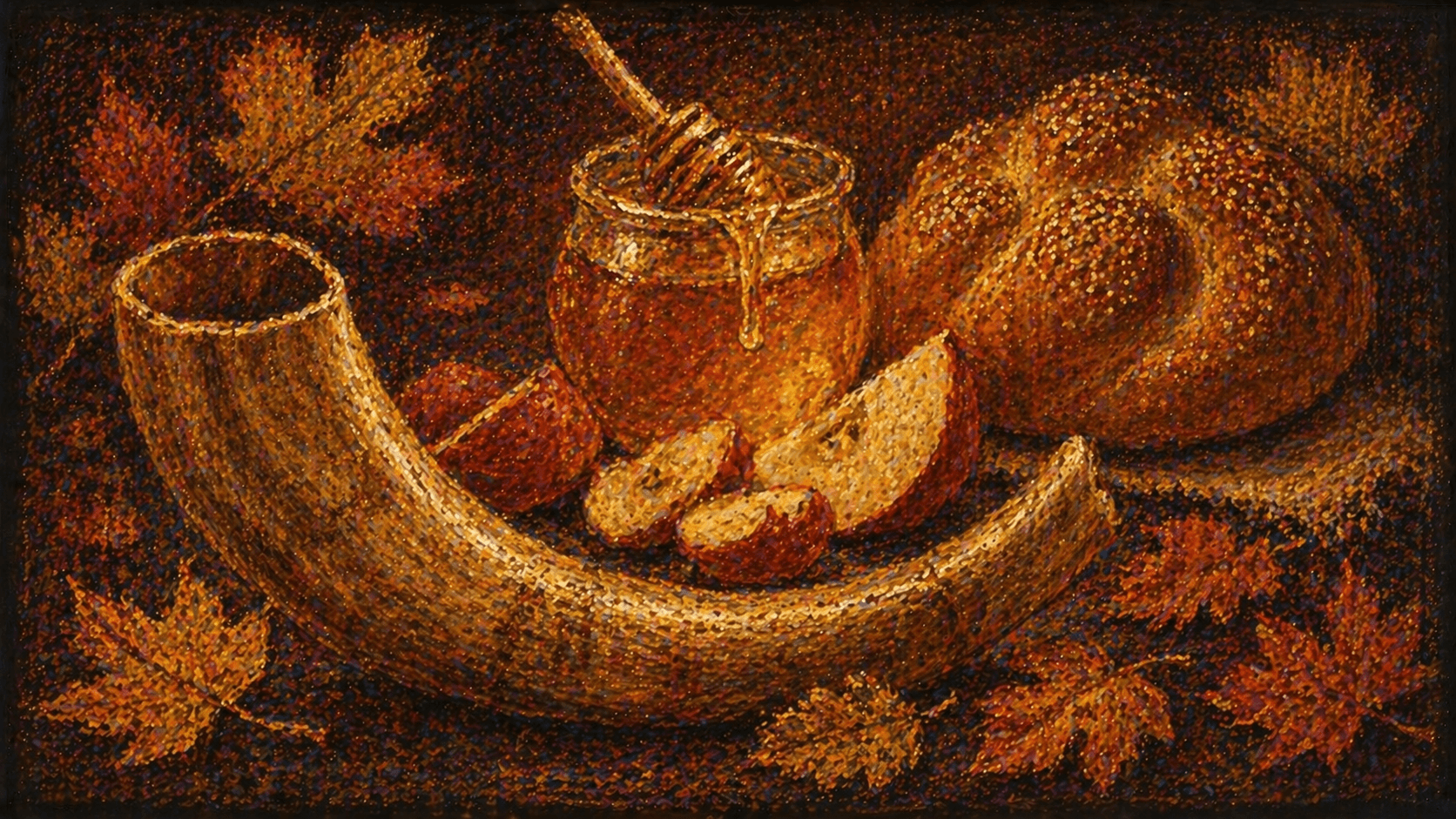
The most important sound of Rosh Hashanah is the shofar — a horn made from a ram’s horn that is curved and golden-brown. When someone blows the shofar, the sound that comes out is unlike anything else. It cries. It wails. It calls. It has been making that sound for thousands of years.
The table at home is set for a big, festive meal. There is almost always a round braided bread called challah — round instead of the usual long shape, because the circle has no beginning and no end, just like time itself.
And then there is honey. Sweet, golden honey, drizzled over slices of apple. Everyone dips a piece of apple and eats it together, wishing each other a shanah tovah u’metukah — a good and sweet new year. The sweetness is not just in your mouth. It is a wish. A hope. A small, delicious prayer.
Some families walk to a body of water — a river, a lake, even a pond — and toss breadcrumbs in. This custom is called tashlich, which means “casting off.” The crumbs represent the mistakes of the past year, floating away downstream. You watch them go. You breathe. You are ready to begin.
You might see
A greeting to know
Shanah Tovah
shah-NAH toe-VAH
“A Good Year”