Vesak
Buddha Day
Celebrating the birth and awakening of the Buddha
The feeling at the heart
Peace
The Story
Close your eyes for just a moment. Imagine a place where there is no rushing, no noise, no worry. Just quiet. Just peace. A deep, still peace — like the whole world is holding its breath.
That feeling is what people reach toward on Vesak, one of the most sacred days of the year.
A very long time ago — more than 2,500 years — a baby was born in a garden. His name was Siddhartha Gautama, and he was born in Lumbini, a place that is now in the country of Nepal. His mother, Queen Maya, gave birth to him under a blossoming tree. The flowers were open. The air was soft.
Siddhartha grew up as a prince, surrounded by comfort and beauty. But something inside him kept asking a question: Why is there so much suffering? Why do people get sick? Why do they grow old? Why do people die, and why does it hurt so much when they do?
He left his palace. He left behind everything comfortable and familiar. For years, he searched.
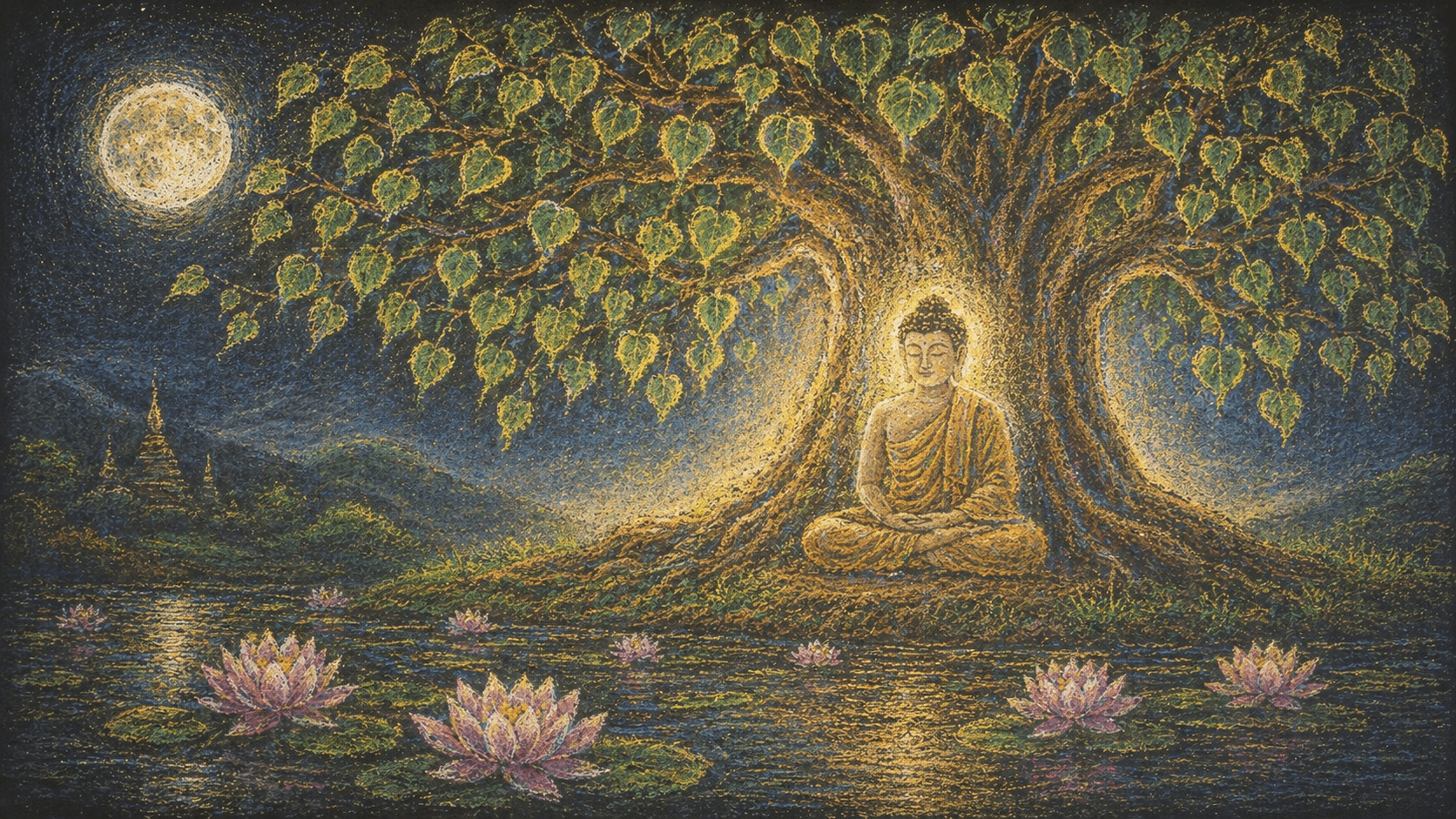
Then one evening, he sat down beneath a fig tree — a tree now called the Bodhi tree, which means “tree of awakening” — in a place called Bodh Gaya, in India. He decided he would sit there and think deeply until he understood. And through the night, something shifted. He understood. He became the Buddha — which simply means “the Awakened One.”
He spent the rest of his long life teaching what he had learned: that suffering comes from craving and clinging, that there is a path toward peace, and that every single person has the ability to find that peace within themselves.
On Vesak, all three extraordinary moments are remembered together — his birth, his awakening, and the day he died peacefully.
How people celebrate today:
Vesak is celebrated in Sri Lanka, Thailand, Vietnam, Cambodia, Korea, and many other countries. It falls on a full moon in spring.
Temples glow. Lanterns — paper lanterns in soft pinks and yellows and whites — are hung in long, swaying lines or sent floating into the night sky. Some places release lanterns into rivers, and they drift away like little lights carrying wishes.
People bring flowers, candles, and incense to temples as offerings. In some places, a small statue of the baby Siddhartha is placed in a bowl, and people gently pour water or flower-scented water over it.
Many people choose to be especially kind on this day. They might bring food to monks, or release animals that were caught — birds, fish, turtles — letting them go free as a symbol of compassion.
The air smells of incense and flowers. The sound of chanting rises and falls like breathing.
And through all of it runs that same thread: the belief that peace is not only possible — it is waiting, right inside each of us, to be found.
You might see
A greeting to know
Happy Vesak
VEH-sahk
“Happy Vesak Day”