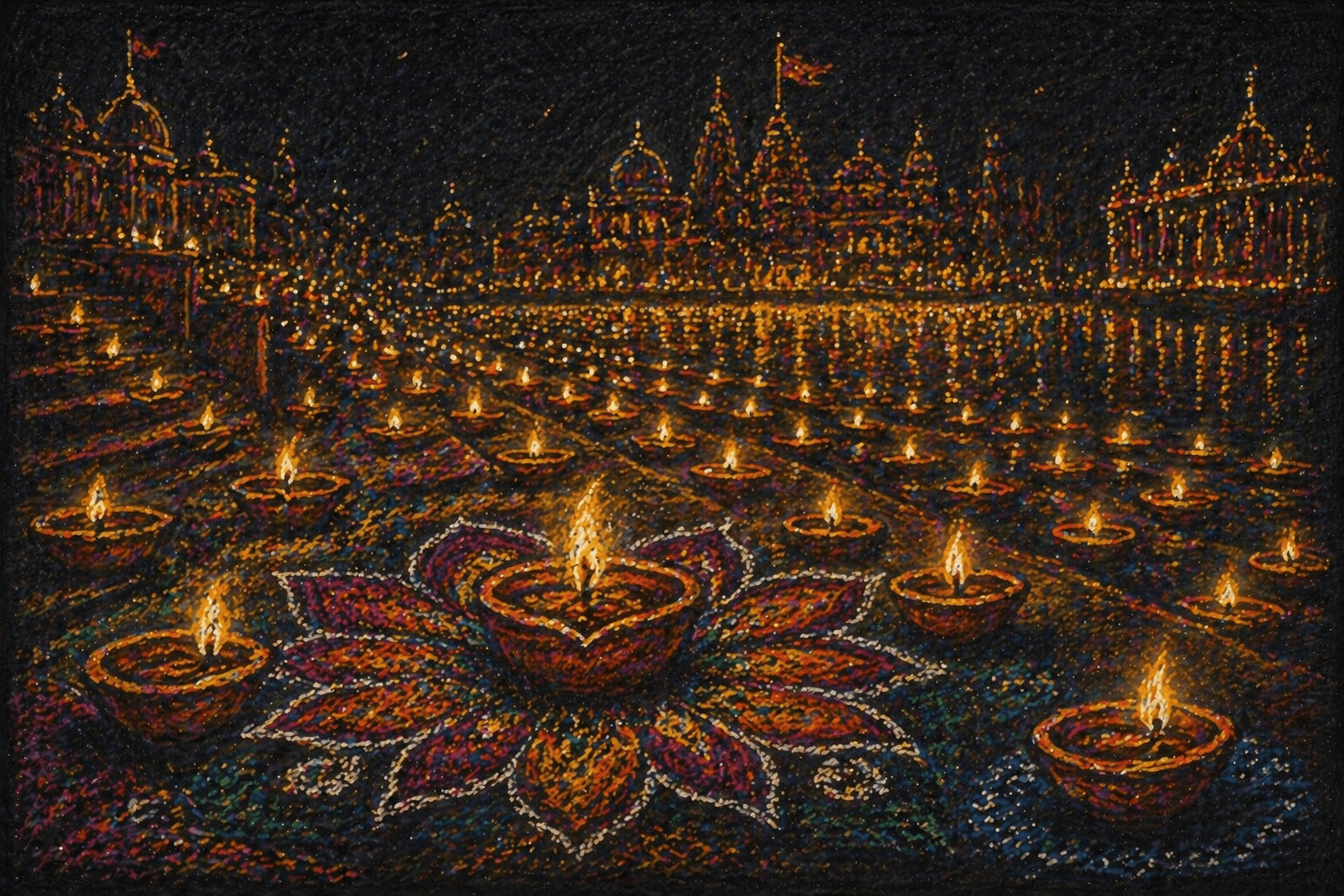
Diwali
Festival of Lights
The festival of lights celebrating good winning over darkness
The feeling at the heart
Triumph
The Story
Do you know the feeling when someone you love has been gone a long time — really gone, and you weren’t sure they were coming back — and then there they are? Right there, in front of you?
Imagine a whole kingdom feeling that at once.
Long ago, there was a prince named Rama. He was good and just and loved deeply by his people. But a promise made to an old queen sent him into exile — banished to the forest for fourteen years. His wife Sita and his brother Lakshmana went with him.
The fourteen years were not peaceful. The demon king Ravana — powerful, ten-headed, brilliant in terrible ways — stole Sita away and carried her across the sea to his island kingdom of Lanka.
Rama searched. He crossed impossible distances. He built an unlikely army — led by the extraordinary Hanuman, who loved Rama so completely that he leapt across the whole ocean to find Sita and tell her help was coming.
The army built a bridge of stones across the sea. They fought the battle of Lanka. And at the end, Ravana fell.
Sita was free. Rama had kept his word.
And then the fourteen years were finally up. Rama and Sita and Lakshmana turned toward home.
It was the dark of the moon — the darkest night of the month, in the darkest month of the year. The people of Ayodhya had been waiting fourteen years. They lit lamps. Not one lamp or two lamps, but every lamp they had — clay diyas filled with oil, with tiny flames floating on wicks — and they placed them on every windowsill and every rooftop and every doorstep and every path, so that the ones they loved would not have to come home in the dark.
The whole city blazed.
That is Diwali. The festival of lights. The night when darkness was answered with ten thousand fires.
How people celebrate today:
Houses are cleaned from corner to corner — because Lakshmi, the goddess of prosperity, is said to visit on Diwali night, and she will enter a home that is clean and welcoming. Doorways are decorated with rangoli — intricate patterns made of colored powder or flower petals.
On Diwali evening, diyas come out. Little clay lamps, dozens of them, sometimes hundreds, placed everywhere. Electric lights wrap around balconies and trees.
Families gather. There are sweets everywhere — barfi, ladoos, crispy chakli and creamy halwa — all given as gifts to neighbors and friends.
At Lakshmi Puja, the family sits together for prayers, welcoming the goddess with flowers and incense and light.
Then fireworks. Bright explosive chrysanthemums in the sky. Children wave sparklers in slow arcs and write their names in light that hangs for just a second and then is gone.
But the diyas stay lit. They burn through the whole long night, small and steady and warm, the way people have always answered darkness: not by looking away, but by lighting something, and letting it shine.
You might see
A greeting to know
Shubh Diwali
SHOOBH dee-WAH-lee
“Happy Diwali”