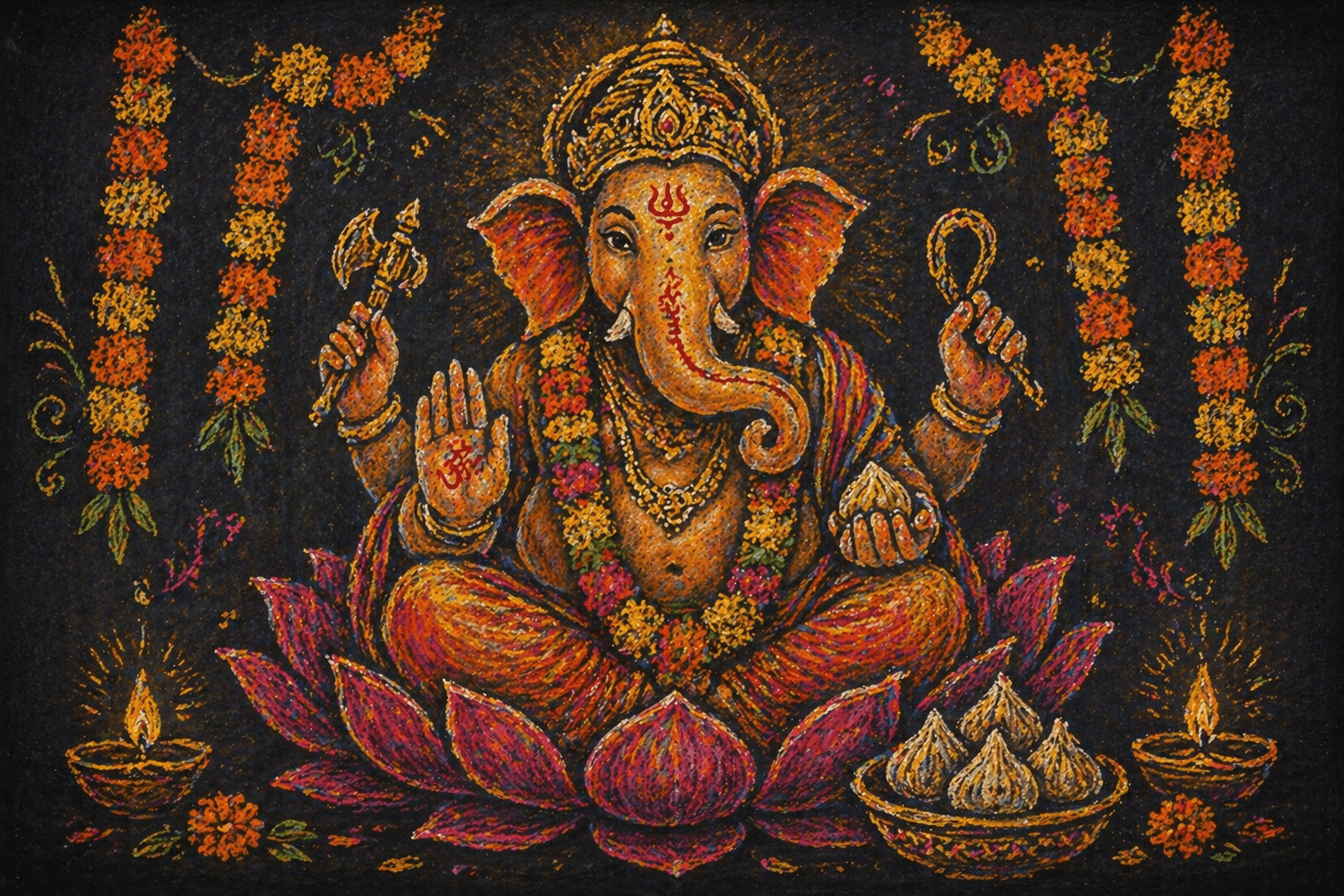
Ganesh Chaturthi
Birthday of the Elephant God
Welcoming the wise, elephant-headed Ganesh into homes and hearts
The feeling at the heart
Welcome
The Story
Before you start anything big — a long trip, a hard problem, a new beginning — have you ever wished someone was watching out for you? Someone who understood that the road ahead has bumps, and who could help clear them?
There is a god for exactly that. And his story begins with a mistake, and a great love, and something lost that became something more.
His name is Ganesh, and his mother was the goddess Parvati.
Parvati had made Ganesh herself — from the turmeric paste she used while bathing, shaped with her own hands, and breathed into life. She placed him at the entrance to her home as a guardian. “Let no one pass,” she told him, “while I am inside.”
He was a good and loyal son. He stood his post.
Not long after, the great god Shiva — Parvati’s husband, but a god who had been away — came home. He had never seen this boy before.
“Let me pass,” said Shiva.
“No,” said Ganesh. “My mother has given me orders.”
They argued. Then they fought. And Shiva, in his anger, struck off the boy’s head.
When Parvati heard what had happened, her grief was enormous. The whole world trembled.
Shiva understood he had made a terrible mistake. He sent his followers out immediately: go north, find the first living creature you come upon, and bring its head. They found an elephant sleeping by the river.
Shiva himself placed the elephant’s head on the boy’s shoulders and breathed life back into him. Then he made a promise. Ganesh would be honored before all other gods. He would be the remover of obstacles — the one who clears the path.
How people celebrate today:
Ganesh Chaturthi lasts for ten days, and it begins with a welcome.
Families bring home a murti — a beautiful clay statue of Ganesh, decorated with orange marigolds, red hibiscus, and garlands of green leaves. They place him on a special seat, as an honored guest. Every day they bring him offerings: coconut, jaggery, and especially modak — small dumplings filled with sweet coconut and palm sugar, said to be his favorite food.
Every morning and evening there are prayers and songs, the smell of incense curling through the room, the small flame of a lamp moving in careful circles.
On the last day, the family carries the murti in a procession to a body of water — a river, a lake, the sea — with music and dancing and the bright crash of drums. Then, gently, they place Ganesh into the current.
It is called visarjan — a farewell. But not a sad one. The idea is that Ganesh carried away with him everything that was heavy, every obstacle in the family’s path.
The path ahead is clear.
You might see
A greeting to know
Ganpati Bappa Morya
GUN-puh-tee BUP-pah MOR-yah
“Hail Lord Ganesh”